
Block Escape Puzzle Tips: Clearing a Path in Fewer Moves
Ten sliding block escape tactics, ordered by when they apply: reading the blocker chain, protecting empty space, and unwinding a board you've tangled.
4 min read
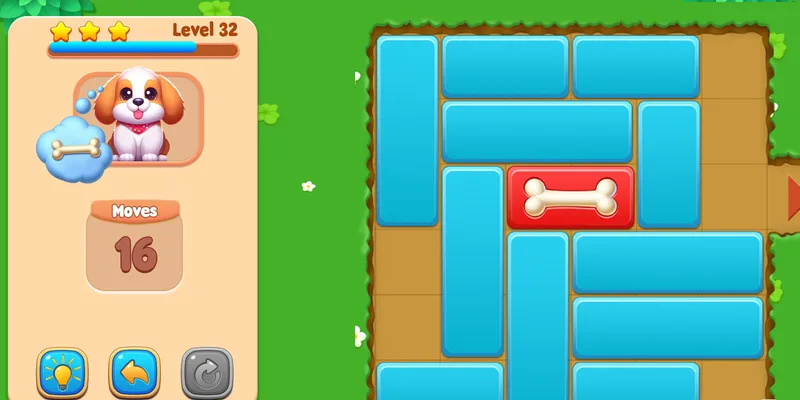
Sliding block levels get harder in a specific way: not more pieces, but longer dependency chains. The tactics below are ordered by when they matter: what to do before your first move, during the untangling, and when the board has gone wrong.
Before the first move
1. Solve the exit lane, not the board. In a single-target level, only the pieces sitting between the target and the exit have to move. Identify them first. Half the board is often irrelevant, and treating it as relevant is what makes an easy level feel hard.
2. Trace the chain backwards. For each blocker, ask which direction it can travel and what stops it. Then ask the same of whatever stops it. You'll usually find a piece that can move right now with nothing in its way. That's your first move, and it's frequently nowhere near the exit.
3. Pick the shorter of two directions. Most blockers can technically go either way. Prefer the direction that needs fewer other pieces to move, even if it looks like it's going the wrong way. Distance from the exit doesn't matter; the number of dependencies does.
During the untangle
4. Park blockers on the edge. Empty space is the resource these puzzles ration, and space is only useful when it's contiguous. A blocker pushed to the rim leaves the centre open; the same blocker pushed to the middle cuts the free space in two and strands both halves.
5. Move long pieces first, when you have a choice. A four-cell block needs four cells of clear runway. Short pieces can slot into leftovers. Doing it the other way round means discovering, three moves later, that the big piece has nowhere left to go.
6. Don't move the target early. Sliding the escape piece up the lane before the lane is clear does nothing except take away the space you were about to need. It's the single most common wasted move. Move it once, at the end.
7. Watch for pieces that block two things at once. On tight boards, one blocker often sits in both the exit lane and the path of another blocker. Clearing it early buys two moves for the price of one. Leaving it late tends to be what makes a board feel unsolvable.
In clear-the-board levels
8. Exit order is the puzzle. When every piece has to leave (as in Block Slide: Color Master, where each block leaves through its own colour door), a piece removed is space gained permanently. Look for the block that's already lined up with its door and take it, even if it isn't the one you were planning around. Each departure loosens the rest of the board.
9. Don't strand a colour behind a full edge. A block can only leave through the door matching it, so a piece pushed to the wrong edge has to be walked all the way back around. Before parking anything, check which edge its door is on and park it on that side of the board.
When the board has gone wrong
10. Recognise a tangle early and undo it. These puzzles have no timer and no move limit worth respecting on a first attempt, so the cost of backing out is close to zero. If you've made five moves and the exit lane is no clearer than when you started, you're not one clever move from the answer. You've probably filled the space you need. Undo back to the last board you understood, or restart.
Restarting is cheap here in a way it isn't in most puzzle genres. Nothing is randomised: the level you restart is the exact level you just failed, and you already know which first move doesn't work.
Plan destinations, not directions
Count the blockers before you touch anything, and give each one a destination: not just a direction, but a specific place on the board where it will be out of the way and stay out of the way. Players who plan destinations solve these in a handful of moves. Players who plan directions shuffle for a minute and get there anyway, but they stall the moment the chain gets four links long.
New to the genre? Start with how to play block escape puzzles.